
E85 and flex fuel on a K20 or K24 with Hondata and FuelTech
Published
Pump E85 is a 51% to 83% ethanol blend in the US, not a fixed 85%. This guide covers the KPro4 frequency input, the FlashPro analog and CANFlex routes, FuelTech, and the fuel, start and spark corrections that follow.
A K-series calibration that assumes every E85 fill contains 85% ethanol can miscalculate fuel, starting enrichment and spark compensation. Use the measured tank content as the reference.
The page covers port-injected K20 and K24 engines on Hondata KPro4 and FlashPro, and FuelTech FT450, FT550 and FT600. It starts with the blend, then the sensor route, then the corrections. The limit is fuel-system capacity, not the ethanol number on the display.
- US pump E85 is a 51% to 83% ethanol blend. Measure the tank, not the label.
- Lambda is the stable unit. A gasoline display can show 14.7 at lambda 1 on E85.
- KPro4 native flex is PRB or PRA only, with a 50 to 150 Hz sensor and a built-in 2.4 k ohm pull-up.
- FlashPro ECT2 and CANFlex are application-specific. Do not wire a frequency sensor to a 0 to 5 V input.
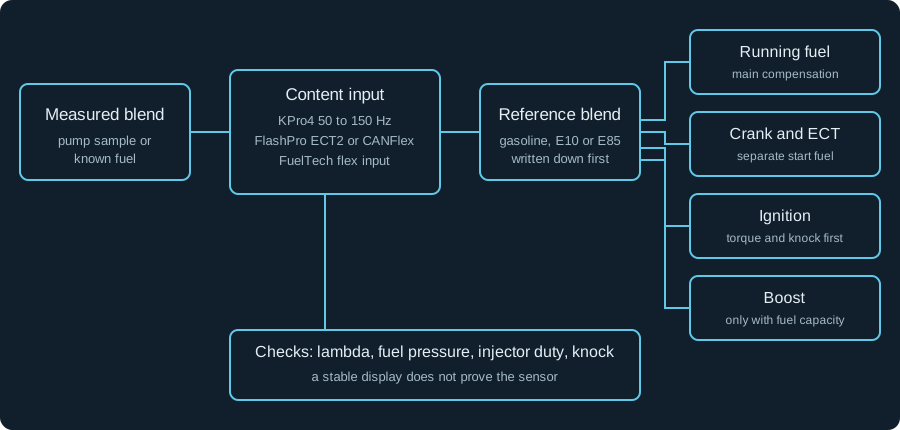
- Running fuel, cranking fuel, ignition and boost are separate corrections.
- E85 is not a timing adder and it does not add injector or pump capacity.
Full Custom: $249 $199 launch special. Most files in 3–5 business days after complete inputs; the outside limit is 7 business days.
Port-injected K20 and K24 only. The turbo Civic is the separate turbo section on the same Honda & Acura hub. Hondata or FuelTech hardware and credits are not included. How files are handled.
1. The boundary: port-injected K20 and K24
This page covers the port-injected engines below. The year gets you close. The ECU, the calibration and the fuel system settle the rest.
| Car or swap | Engine | Control route | What to confirm |
|---|---|---|---|
| 2002–2004 RSX | K20A2, K20A3 | KPro4 in an eligible 2002–2004 ECU | PRB or PRA calibration, wideband circuit, sensor return line |
| 2002–2005 EP3 Civic | K20A3 | KPro4 in its PNF ECU | A PNF calibration does not meet the documented PRB/PRA flex gate |
| 2005–2006 RSX | K20Z1, K20A3 | KPro4 on a modified 2002–2004 ECU with adapter | PRB or PRA calibration, earlier primary O2, return-line flow |
| 2006–2011 Civic Si | K20Z3 | FlashPro | Ethanol input is listed for this application; confirm the supported route in the actual calibration |
| 2012–2015 Civic Si; 2013–2015 ILX 2.4 manual | K24Z7 | FlashPro | Check the software build; 4.7.4 fixed a 0% display on the 2012–2015 Si |
| 2004–2006 TSX | K24A2 | FlashPro conversion with a 2007–2008 ECU | ECU and adapter identity, ECT2 or CANFlex availability |
| 2007–2014 TSX four-cylinder | K24 | FlashPro, supported ECU list | RBB or RL5, input route, market |
| Cable-throttle K swap | K20 or K24 | KPro4 in an eligible ECU, or FuelTech | PRB or PRA gate for KPro4; FT450 has no drive-by-wire |
The US 2013–2017 Accord 2.4 K24W is direct injection and uses a different fuel system. No port-injector flow, dead time or flex recipe on this page applies to it. K20C, L15, B/D and s300 work sit outside this wave.
KTuner is not covered here, and FuelTech on a K has its own setup page.
2. The pump label is not the blend
The current US pump range is 51% to 83% ethanol. The fuel specification uses the same window. That is the range the pump can deliver, not a measurement of the tank you just filled.
- The blend moves stoichiometry, energy per gallon, vaporization and knock margin. It does not carry one fixed octane number. No exact content-to-AKI conversion is established here, and no fixed AKI rating is printed.
- Lambda is actual air-fuel ratio divided by the fuel's stoichiometric ratio. A wideband calibrated to gasoline displays lambda times 14.7. At lambda 1 it can show 14.7 on E85 even though the physical ratio is lower. The display is a scale, not a fuel identity.
- Take a display of 11.8 on the gasoline scale. Divide by 14.7 and the sample is lambda 0.803. If the blend's stoichiometric ratio is near 9.8:1, the physical ratio is near 7.9:1. The same 11.8 display on gasoline is 11.8:1 physical. That is why “11.8 AFR on E85” needs the scale named.
- Work in lambda, or write down both the display scale and the assumed stoichiometric ratio. The fuel table pages use lambda for the same reason. A gasoline-scale target can represent the same lambda on either fuel. Changing the display unit does not change fuel delivery or calibrate an ethanol blend.
- A blend estimate is arithmetic. Ten gallons of E70 plus five gallons of E10 gives
(10 × 70 + 5 × 10) / 15 = E50by volume, assuming no other contents. That is a planning number for the tank. The rail sees the blend only after the fuel has circulated. Compare the sensor with a fuel sample measured independently. A matching pump label is not that check.
3. Choose the sensor route before the sensor
Three routes look similar on a parts list and behave differently at the ECU. KPro4 reads a frequency. FlashPro ECT2 reads a conditioned 0 to 5 V signal. FlashPro CANFlex reads content over CAN. FuelTech uses its own flex input and FTManager setup.
A sensor that suits one route may not suit another.
| Route | Signal | What it expects | First check |
|---|---|---|---|
| KPro4 ethanol input | Frequency, 50 to 150 Hz | KPro4 with a PRB or PRA calibration; GM-style content sensor; built-in 2.4 k ohm pull-up | Calibration identity, return-line flow, supply voltage |
| FlashPro ECT2 | 0 to 5 V analog | A supported vehicle, a control unit with a voltage output, ECT2 disabled in miscellaneous parameters | Application support, transfer points, low-content readability |
| FlashPro CANFlex | CAN message | A supported vehicle and Hondata CANFlex hardware | Software and firmware support for that application |
| FuelTech flex input | Sensor input to the ECU | FT450, FT550 or FT600 with the flex function enabled in FTManager | Sensor reading, reference blend, failure content |
On KPro4, the sensor is a digital input. The documented sensors produce a pulse-width signal whose frequency runs from 50 Hz at 0% to 150 Hz at 100%. The input has a built-in 2.4 k ohm pull-up, so no extra resistor is wired between output and supply.
The sensor belongs in the return line from the rail to the tank, where fuel flows past it whenever the pump runs. Flow direction does not matter.
- For this KPro4 installation, confirm content with fuel flowing. With the pump stopped, the displayed value is not a fresh tank measurement. KPro4 also holds the last content value for cranking. At restart, that value can be the old tank until the pump has circulated the new fuel. KManager describes an update after 10 to 15 seconds of running in normal conditions.
- The frequency convention is linear in the documented range. Subtract 50 from the frequency to get ethanol percent: 120 Hz is 70%, not 120%. An out-of-range value needs diagnosis and a check of the ECU's actual response. Do not assume every ECU recognizes every sensor fault.
Swipe or use the arrow keys to read every label.
More details
FlashPro ECT2 cannot read a raw frequency sensor. It needs a conditioned analog signal and exists only on supported vehicles. The signal wire goes to the ECT2 pin, and ECT2 has to be disabled in the software under miscellaneous parameters.
The ECU input has a pull-up to 5 V, and some analyzers cannot pull the output low enough for a correct low-content reading.
- The documented FlashPro examples show the limit. A Zeitronix ECA is listed at 0.34 V for 0% and 4.97 V for 100%, and it will not read below 15% ethanol. An Innovate ECF-1, MTX-D or ECB-1 is listed at 0.00 V and 5.00 V, and it will not read below 1.5%. Those are examples for those units, not a universal transfer table. Calibrate the transfer you actually have.
- CANFlex also exists only on some vehicles. There is no blanket support for every older K. Open the calibration and look for the ethanol parameters before assuming the route exists. The 2006–2011 Civic Si feature list includes an ethanol input. If the menu is missing, check the application, software and calibration before assuming it needs a fixed-blend tune.
A 2012–2015 Civic Si K24Z7 once showed 0% ethanol with a valid sensor. FlashProManager 4.7.4 on 10 July 2026 fixed that display. A later compatible build includes that fix. Check the installed version and applicable firmware before replacing a sensor or draining a tank.
4. KPro4: enable the input, then check every table
Start with the calibration identity. KPro4 native flex is documented for PRB or PRA. A PNF EP3 calibration does not meet that requirement. ECU case identity alone does not establish the calibration family. KPro3 and earlier do not have this input.
- The reference blend is a tuning decision. If the car already runs on high ethanol, use that as the reference deliberately. Enabling a gasoline-based enrichment table on an E85-referenced file can add a second correction on top of the first.
- On KPro4,
Ethanol content input enabledenables both the input and the compensation tables. A monitoring-only setup still has to define those tables so they do not add fuel or spark. Decide what the reference is before the first start.
- Establish the low-blend baseline. Record the calibration, injector data, pressure, pump supply and a lambda log on the fuel the car runs now.
- Check the hardware gate. KPro4, PRB or PRA, and a calibration that exposes the Ethanol menu. Save the as-found file before the edit.
- Install the sensor in the return line. The documented GM sensors use a 9 to 18 V supply, ground and an output to the KPro4 ethanol input. Confirm connector orientation before wiring.
- Enable the input and inspect every compensation table. Fuel, ECT, cranking, cranking ECT, ignition and boost. Write down the reference and the current values.
- Compare the sensor with a known sample. Check it first at idle with fuel circulating. Resolve discrepancies before checking the reading under load.
- Tune running fuel at the endpoints first. Low blend and high blend, then intermediate blends. Use lambda and fuel pressure, not the pump label.
- Calibrate cranking and ECT separately. Repeated genuine cold soaks. Running fuel compensation does not cover cranking.
- Set ignition from torque and knock. After fuel is correct. One region at a time. No fixed adder.
- Add boost only if the fuel system has capacity. The ethanol number does not create pump or injector headroom.
- Test the failure behavior and archive the result. Record unplugged-sensor behavior, retained content, refuel transition and the exact software build. Do not assume an automatic fallback exists.
| Control | What it changes | What it is not |
|---|---|---|
| Ethanol content input enabled | Enables the input and the compensation tables | A monitoring-only switch |
| Smoothing time factor | How fast the content value follows a change | A fuel delivery or content target |
| Maximum engine speed for update | Stops sensor reads above a chosen rpm | A rev limit or a content limit |
| Ethanol fuel compensation | Running fuel change by content, open and closed loop | A target lambda table |
| Ethanol ECT compensation | Fuel change by coolant temperature, applied on a 100% basis | A cranking table |
| Ethanol cranking compensation | Extra fuel while cranking | Covered by running fuel compensation |
| Ethanol cranking ECT compensation | Cranking fuel by coolant temperature | A warm-up fuel table |
| Ethanol ignition compensation | Added advance by content, open and closed loop | An instruction to add timing at every load |
| Ethanol boost compensation | Sets boost by interpolating the low and high gear-based tables by content; gear-based mode is required, and the high switch setting overrides it | A base fuel correction |
The ECT table is applied on the basis of 100% ethanol. A table value of 20% at E100 contributes 15% at E75. That is an example of proportional application, not a cold-start value to copy. The same logic applies to the cranking ECT table.
- Smoothing is a real tuning variable. A factor of 1000 can take about 10 minutes for a full-scale change. A factor of 10 responds almost immediately. The content after a refuel is described as updating after 10 to 15 seconds of running. A stable but stale reading can be more dangerous than a fault because it looks valid.
- The maximum engine speed for update must stay above fast idle. If it is set below the speed the engine actually runs, the content never updates. That is a configuration error, not a sensor failure.
If the car was already tuned on E85, do not enable a gasoline-reference fuel table and leave the old E85 correction in place. That is double compensation. Pick the reference, write it down, and make the tables agree with it.
5. FlashPro: analog or CANFlex, by application
FlashPro ECT2 needs a sensor and an analyzer with a 0 to 5 V output. CANFlex supplies content over CAN instead. Both routes are application-specific; confirm the calibration and hardware support.
- On ECT2, the signal wire goes to the ECT2 pin and ECT2 is disabled in the miscellaneous parameters. Verify the ground reference and the transfer at both ends. The ECU pull-up can affect the low-content reading, which is why a 5 V full-scale match does not prove the low end is correct. The Zeitronix and Innovate examples above show how different the low-end limits can be.
- On CANFlex, content arrives over CAN without repinning the ECT2 signal. Install the CANFlex hardware and sensor using the instructions for that vehicle. The hardware and the software build still have to support that application. A CANFlex menu on one chassis does not prove it exists on another.
- The compensation structure is not two complete files blended by a straight line. Its generic help names Ethanol fuel compensation, Ethanol ignition multiplier, Ethanol ignition compensation, Ethanol WOT fuel compensation and Boost by ethanol limit. Table availability varies with the application. Where supported, advanced ethanol replaces the simple 2D fuel and boost tables with 3D fuel and boost tables. The ignition result is the compensation value multiplied by the multiplier, then added to commanded timing.
- Do not import K20C direct-injection WOT targets or starting tables into a port-injected K. The fuel system, the injection timing and the ethanol behavior are different. The port-injection fuel page covers the active AFM, MAP or hybrid model; that model still has to be right before the ethanol correction means anything.
- If the loaded calibration has no usable ethanol control, resolve compatibility before attempting flex operation. A dash sensor alone does not supply automatic compensation. Any interim fixed-blend calibration must match the measured fuel.
6. FuelTech: reference blend and separate corrections
FuelTech's setup sequence is explicit. Enable flex under Map Options. Choose the failure content under Other Functions and Flex Fuel. Run the Flex Fuel Wizard to set the reference from the current fuel. Then calibrate the corrections in order.
- The corrections are main fuel injection, engine start and prime pulse, acceleration enrichment, O2 closed-loop target, main ignition and wastegate pressure. They are separate jobs. A running fuel correction does not fix a prime pulse, and an O2 target change is not an air-model correction.
- Record the base map's actual reference blend before running the wizard, and keep a copy. If the base map is an ethanol reference, the low-content correction can be negative. If it is a gasoline reference, the high-content correction is usually positive. The sign is relative to the base. It is not proof that the fueling is correct.
- The failure content is a deliberate choice. An E0 fallback can be conservative for spark and still underfuel a real high-ethanol tank. A high-ethanol fallback can protect fuel and be too much advance for gasoline. Decide which failure is safer for the build, test it at low load, and make fuel, spark and boost fallbacks agree.
- FT450 runs flex fuel and does not drive the throttle. FT550 and FT600 add drive-by-wire. The ECU choice is on the comparison page.
7. Fuel demand and injector capacity
Ethanol needs more volume for the same mass of air. The exact increase depends on the blend, the fuel density, the stoichiometric ratio and the base fuel. A 30% figure is an example, not a calibrated requirement for every E85 tank.
- If measured demand rises 30%, a first estimate takes 75% duty to 97.5%, or 80% to 104%. Neither leaves usable reserve; an injector cannot deliver above 100% duty. This assumes unchanged differential pressure and ignores dead time, so use the actual pulse width and pressure to check capacity.
- Hold air mass and lambda constant. Changing assumed stoichiometry from 14.7 to 9.8 requires
14.7 / 9.8 = 1.50times the fuel mass. Volume demand also depends on density: multiply that result by baseline density divided by new-fuel density. This is why the 30% duty example cannot set an ethanol compensation table. - Read the injector size and the pressure it was rated at. Read the fuel pressure, the duty cycle, the pump voltage and the rail differential pressure. Fuel temperature, filter condition and line and seal compatibility matter with ethanol. An ethanol sensor does not supply more flow.
- The ID1050-XDS is rated at 1065 cc/min at 3.0 bar with gasoline at 52 °C. That is a flow rating at a test pressure. It is not an E85 horsepower rating, and it is not a recommendation for a particular build. The same injector can be enough on one engine and short on another.
- Do not change the stoichiometric ratio and then scale the injector flow by the same ethanol fraction. That double-counts the same correction. Choose one reference and one correction path, then measure lambda. If the base fuel model is wrong, fix the model before adding an ethanol multiplier.
- If a running-fuel compensation already adds 20% and testing calls for 35% total, change +20% to +35% in that path. Adding a separate 35% multiplier produces
1.20 × 1.35 = 1.62, or 62% total. The intended increase from the present quantity is1.35 / 1.20 = 1.125, or 12.5%. These are arithmetic examples, not fuel settings.
8. Cold start, hot restart and driveability
Ethanol vaporizes poorly compared with gasoline. It has a higher latent heat of vaporization and a higher flash point. A cold engine can need more start fuel than the running correction supplies. KPro4 has separate cranking and cranking ECT tables. FlashPro has its own starting-fuel controls.
FuelTech separates Engine Start and Prime Pulse Compensation from running fuel.
- KManager already rescales cranking fuel when Injector Size changes. Do not apply another injector-size ratio to the cranking table after entering the new size. Use the correct voltage compensation, then adjust the ethanol cranking and temperature corrections for the measured blend.
- Test on genuine cold soaks. Record ethanol content, ECT and IAT, battery voltage, time to fire and sustained idle. Repeat the same soak before and after the change. A warm restart after a short key-off is a different test from an overnight soak, and a heat-soaked restart is different again.
- The content retained at restart can be the old tank. The fresh fuel needs circulation before the rail sees it. Do not chase a start problem with a cranking multiplier until the content reading and the fuel pressure are known. A weak pump or the wrong injector dead time can look like a cold-start calibration error.
- The idle and injector page owns dead time, injector size and idle air. This page owns the blend and the ethanol-specific start corrections.
9. Spark, knock, boost and cam angle
E85 is not an automatic timing adder. Pump E85 does not carry one fixed octane number, and no exact content-to-AKI conversion is established here. No fixed AKI rating and no fixed degree adder are printed. A higher ethanol content can improve knock margin without requiring more advance.
More details
The ignition and knock page treats MBT and the knock limit as different constraints. MBT is the advance that reaches the torque plateau. The knock limit is where the engine begins to knock. If the engine is already at the plateau, the extra knock margin adds headroom but not a need for more advance. If it is knock-limited, the fuel can let you approach the plateau. Measure torque and knock in both cases. A log without a torque measurement cannot establish MBT.
KPro4's ethanol ignition compensation adds advance by content. Calibrate it after the fuel is correct. Change one load region, check torque and knock, and keep the change only if the result supports it. Do not reduce knock sensitivity because the engine is noisy.
That hides the count without proving the count is false. One count is not harmless by default.
E85 does not change mechanical clearance. It can change the torque and knock constraints under which a cam target is evaluated, but there is no universal ethanol cam adder. Piston-to-valve clearance remains the builder's measurement, and the VTC page owns the target and the VTEC check.
Boost is a capacity question before it is a fuel question. More ethanol can improve knock margin while using up injector and pump headroom. On KPro4, ethanol boost compensation sets the boost level by interpolating between the low and high gear-based boost tables from ethanol content.
It works only when gear-based boost control is the active mode. A low/high boost input overrides the ethanol compensation when the switch is on high. The high boost table is then used as-is at any ethanol content. On the low setting the ethanol compensation still runs.
Setting Boost low/high % to 0 disables the ethanol boost compensation.
Where the application exposes it, FlashPro's Boost by ethanol limit reduces the TC maximum pressure target as content falls. Calibrate that pressure table for the high-blend endpoint, then check the limits at lower blends. On FuelTech, wastegate pressure can be trimmed by content.
None of these paths creates fuel capacity, and none of them supports a universal boost ceiling.
E85 does not prevent preignition, overheating, excessive cylinder load, fuel starvation or mechanical failure. The blend is one variable. The log still has to show fuel pressure, lambda, knock and temperature behaving.
10. Validate the blend, not one tank
One tank is not a validation. The car has to start, idle, cruise, take load, refuel and recover from a sensor fault at more than one content. The table below is the minimum sheet for a flex calibration.
| Event | What to record | Pass condition |
|---|---|---|
| Low-blend baseline | Content, lambda, fuel pressure, duty, trims, knock | Lambda follows target, trims are stable, no new knock |
| Intermediate blend | Content after circulation, the same channels | The correction lands between the endpoints without a step |
| High-blend endpoint | Content, lambda, duty, pressure, knock, torque evidence | Fuel demand is inside capacity and spark is supported by the result |
| Cold start | Content, ECT, IAT, voltage, time to fire, idle | Starts and holds idle without a pedal |
| Hot restart | Same channels after a heat soak | Start and idle repeat, no new fault |
| Refuel transition | Content before, during and after circulation | The reading moves toward the measured blend and settles |
| Sensor failure | Detected fault or retained content, fuel, spark and boost response | Actual behavior is known; any supported fallback is consistent across fuel, spark and boost |
| Boost transition | Content, boost target, duty, lambda, knock | Boost follows the content limit and fuel demand stays inside capacity |
A matching lambda with a steady +15% short-term trim means feedback is adding fuel. Diagnose pressure, injector data and sensor scaling before changing the base model. In a stable cell with no other trim, the delivered quantity is base × 1.15.
Moving that correction into the base requires another log as feedback settles. Include long-term trim when it is active; do not count the same correction twice.
- A stable content display is not proof the sensor is valid. Check the signal against a known sample, check the update after a refuel, and check the software version. A frozen plausible value can hide a real blend change.
- The Honda logging page covers the export and the channel definitions. Archive the calibration, the native log, the CSV export, the software build, the measured content and the fuel pressure. Include content and software version so another tuner can interpret the log.
11. Numbers used on this page
None of these is a target unless the row says so. Everything else comes from the calibration, the sensor or the log.
| Number | What it applies to | How to read it |
|---|---|---|
| 51% to 83% ethanol | US pump E85 | Current range. The pump is not a measurement. |
| 50 to 150 Hz | KPro4 PRB or PRA ethanol input | 0% to 100% in the documented convention |
| 2.4 k ohm | KPro4 ethanol input pull-up | Built in. No extra resistor between output and supply. |
| 10 to 15 seconds | KPro4 content update after refuel | With fuel flowing and the engine running |
| 1000 and 10 | KPro4 smoothing time factor | About 10 minutes for full scale, or nearly immediate |
| 20% at E100, 15% at E75 | KPro4 ECT compensation example | Proportional application, not a cold-start value |
| 0.34 V and 4.97 V | Zeitronix ECA on FlashPro ECT2 | Example transfer. It will not read below 15% ethanol. |
| 4.7.4, 10 July 2026 | FlashProManager | Fixed the 2012–2015 Civic Si flex fuel 0% display |
| 1065 cc/min at 3.0 bar | ID1050-XDS | Gasoline at 52 °C. A flow rating, not an E85 power rating. |
| E50 | 10 gal E70 plus 5 gal E10 | Nominal volume blend, before circulation |
| 97.5% and 104% | 75% and 80% duty with 30% more demand | Arithmetic example, not a required correction |
| 14.7 and 9.8 | Gasoline display and high-ethanol stoichiometry | Lambda 1 on a gasoline scale. The blend ratio moves with content. |
Questions
Can I just fill E85 on my gasoline tune?
No. The calibration must supply the measured blend's fuel demand and starting enrichment. Pump and injector capacity also need checking. Use an established flex calibration or a separate file tuned for that fixed blend.
Why does ethanol content drop randomly at idle or while driving?
Log content beside battery voltage, rpm and fuel pressure. Check sensor supply and ground under the electrical load that triggers the drop. One KPro4 owner reported restoring the reading after fixing a loose pump-outlet clamp and a priming problem. That is one reported repair, not proof every drop means bubbles.
Check fuel delivery before relocating the sensor or adding smoothing. Keep the documented return-line installation unless the hardware supplier specifies another arrangement.
Is 120 Hz 120% ethanol?
No. The documented KPro4 convention is 50 Hz at 0% and 150 Hz at 100%. Subtract 50 and 120 Hz is 70%. Verify unexpected readings against an independently measured sample and check how the ECU handles an invalid signal.
Can I use the sensor as a gauge only?
Only if you know what enabling it does. On KPro4, the input enable also enables the compensation tables. A monitoring-only setup has to define those tables so they do not add a second correction. On FlashPro and FuelTech, the same question applies to each compensation path. Decide the reference before you enable.
Why is power down with high ethanol?
More ethanol does not mean more power. Check fuel capacity, actual lambda, fuel pressure, temperature, ignition constraints and sensor correctness. If injector duty is maxed or the pump is out of flow, the engine is lean or the calibration is protecting it.
A high content reading is not proof the system can supply it.
Does E85 need three times the cranking fuel?
There is no multiplier that fits every temperature, blend and injector. Check cranking voltage, fuel pressure and injector data first. KPro running-fuel compensations do not apply during cranking. Adjust Ethanol cranking compensation and Ethanol cranking ECT compensation separately, using repeated cold soaks.
If it fires and then stalls, log the transition into running fuel before adding more cranking enrichment.
Can KPro3 read the GM sensor if I add a converter?
KPro3 lacks KPro4's native frequency input. A converter and analog channel may provide a displayed content value, but that does not establish automatic ethanol compensation. Confirm the converter's voltage range and the analog transfer before trusting the display. Use a measured fixed blend unless the complete control path has been demonstrated.
Can I switch gasoline and E85 maps without a sensor?
Only with fuel that matches the selected fixed-blend calibration. Residual fuel changes the next fill: the ten-gallon E70 and five-gallon E10 example produces E50. Neither a gasoline file nor an E70 file automatically accounts for that result. Measure the mixed fuel and use a matching calibration before applying load.
Changing the target display to lambda does not make the ECU recognize E50.
Why does it restart rich after I add gasoline to an ethanol tank?
KPro4 retains the last content for cranking. After a large blend change, that value can request high-ethanol starting fuel while lower-ethanol fuel reaches the engine. Compare retained content, fuel pressure and the reading after circulation before changing the cold-start tables. Also check for leaking injectors and incorrect dead time.
A post-refuel problem that disappears after circulation needs a different diagnosis from a repeatable overnight-start problem.
Is a flex tune two complete maps blended linearly?
These systems apply separate fuel, starting, spark and boost corrections to a reference calibration. KPro4's gear-based boost interpolation does not mean it blends every table between two files. Inspect each active correction path.
Does E85 let me add timing?
Only if the measured result supports it. More knock margin does not require more advance when the engine has already reached its torque plateau. Keep the fuel and spark checks separate.
Can I run E85 on a stock K20 or K24 fuel system?
Check injector duty, pump flow, pressure and the condition of the seals and filter at the blend you will run. A stock system may be near its limit on a mild engine and past it on a modified one. No universal horsepower ceiling is printed here.
The log and a flow test decide.
Does E85 change cam clearance or VTC?
Ethanol does not change piston-to-valve clearance. Evaluate VTC for torque within the measured mechanical limits; do not add cam angle just because ethanol content increased.
Send the calibration, the native log, the CSV export, the ECU or device identity, the measured ethanol content and the fuel-system details. Tune Report is free. Honda Full Custom is open at $199 during the launch special ($249 regular).
Every file is compared against our 3 million+ tune values, with a final check-off by our lead tuner.
Tune Report is free if you want this file checked: open the Honda & Acura Tune Report.
A written review of your tune file and one log from your car.
Start a Honda & Acura Tune Report