
10R80 shift tuning for a Coyote 5.0 with HP Tuners
Published
A harsh 10R80 shift needs a log before it needs more pressure. Separate the gear the controller chose from how the clutches completed that change. A schedule edit can change selection; it cannot repair a leaking clutch circuit.
- Log the complaint before adding pressure. A harsh shift is a symptom, not a pressure target.
- Separate the gear the controller selected, the preparation phase and the completed ratio. A schedule edit cannot repair a leaking clutch circuit.
- Keep the original file and learning state while recording. A reset changes the comparison, and a smoother first drive is not a repair.
- Stop if the ratio or shaft-speed signal is inconsistent, or if the fault is mechanical. More pressure can make a hardware problem worse.
Keep the original file and learning state while you record the complaint. A reset changes the comparison, and a temporarily smoother drive does not establish a repaired transmission.
Use the free Tune Report for a readable file and matching complaint log. The log analyzer belongs with the channel setup when you prepare that recording.
Full Custom: $249 $199 launch special. Most files in 3–5 business days after complete inputs; the outside limit is 7 business days.
Coyote 5.0 only. HP Tuners hardware and credits are not included. How files are handled.
What your shop likely changed, in plain words
A firm-shift tune usually changes one of three things. It can change when the controller selects a gear (the schedule). It can change how much pressure or clutch apply the controller commands during the shift. It can change how much engine torque is reduced while the shift completes.
Converter lockup and a raised torque limit are separate changes again.
You cannot tell which one changed from the driver's seat. If you have an earlier file, a comparison shows the table changes. If the shop will not share the file, send the current read and a log that shows the complaint.
We can assess the current behavior and say what the log does not prove; we cannot claim what the other shop changed without their file. That is still a valid free Tune Report, and it is the honest answer before a paid revision.
Identify the vehicle, strategy and transmission before editing
This procedure covers the original Gen 3 2018–2023 Mustang GT application and identified Coyote F-150 5.0 files. The original truck pairing begins with the 2018 F-150 5.0. A 2017 truck ten-speed reference can concern an EcoBoost rather than the Coyote.
Revised 2021-and-later trucks need their own controller and service-applicability check. A 2024-and-later Mustang file is outside these calibration notes.
- Record the vehicle build date, calibration strategy, module IDs, VCM Suite version and transmission identity. Include a replacement valve body, converter, clutch changes and solenoid strategy information. A swapped transmission requires identification of the installed unit and its control system; the engine's generation does not settle that.
- Do not assume every Coyote 10R80 has a separately licensed TCM. HP Tuners documented integrated ECM transbrake control for the 2018 Mustang. That feature does not settle every vehicle's controller layout. Read the modules actually present and confirm the current support and licensing dialog for that vehicle. A GT500 transmission entry or an EcoBoost controller row cannot establish a Coyote charge.
- Save the as-found read before comparing against another file. Check codes, fluid-service history, specified ULV fluid and the vehicle's level-check procedure before calibration work. This page addresses tuning decisions after that baseline; internal repair and pressure-test instructions belong with the applicable service procedure.
Separate selection, preparation and the completed ratio
The selected mode, pedal demand, speed and operating conditions feed gear selection. The controller then coordinates clutch preparation, torque handoff and the change in turbine speed. Engine torque intervention and converter control participate in that event. The gear display can change before the shafts settle at the destination ratio.
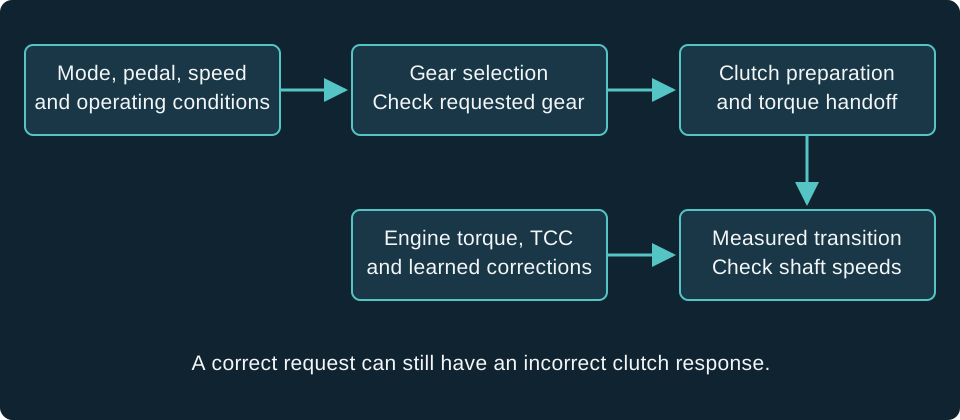
Swipe or use the arrow keys to read every label.
A delayed downshift contains distinct possible delays. The controller might wait before requesting the lower gear, or request it promptly while the ratio transition takes too long. Moving a downshift threshold addresses the first observation. Clutch-phase diagnosis addresses the second. Neither conclusion follows from the driver's impression of lag alone.
- Adaptive corrections compensate for the particular transmission's behavior. They are another input to the result, alongside the base calibration and physical hydraulics. Treat the learning state as part of the test conditions. Comparing an adapted original file with a freshly reset revision combines two changes.
- The ten-speed's control cannot inherit a 6R80 pressure recipe by matching familiar table words. Different clutch combinations and hydraulic arrangements change what the command does. GM ten-speed advice also needs Ford-specific confirmation before its hardware assumptions or parameter meanings become an edit.
Capture the request and the shaft response together
Record the specific event before adding channels for unrelated engine work. Preserve enough data before the complaint to identify the starting gear and converter state. Keep the period after it to see whether the ratio settles or the controller immediately changes its request again.
| Signal group | Useful comparison | Misleading shortcut |
|---|---|---|
| Pedal, mode, vehicle speed and brake state | Same selection conditions before and after the revision | Assuming the dashboard mode names the active schedule |
| Requested and current gear | When selection changes and when the reported gear follows | Treating a gear flag as proof of clutch completion |
| Engine, turbine and output-shaft speeds | Converter speed difference and turbine-to-output ratio | Calling every engine-speed rise internal clutch flare |
| Transmission temperature | Cold complaint versus the same warm event | Comparing unrelated thermal conditions |
| Engine torque estimate and intervention source | Plausible torque input and coordinated reduction through the shift | Reading a torque estimate as measured clutch capacity |
| TCC state and desired/actual slip where available | Controlled converter slip versus incomplete apply | Assuming a generic lock flag requires zero speed difference |
| Clutch commands and learned corrections where exposed | Affected element, phase, load and adaptation | Reading commanded pressure as a physical gauge |
With a settled engaged gear, turbine speed divided by output speed should agree with the identified internal ratio within signal limitations. During a shift, that ratio moves between states. A flare or bind assessment needs the trajectory, engine torque and phase context, rather than a universal duration threshold.
- If engine speed rises while turbine speed remains consistent with the gear, inspect the converter event first. If turbine speed also departs from the expected transition, investigate clutch control and physical response. Missing turbine data limits that distinction; do not invent it from engine rpm when converter slip is changing.
- Check sample timing and signal dropouts before interpreting a short disturbance. An apparent lead or lag can come from channels updating at different rates. The Coyote logging guide covers the broader channel setup; this comparison needs a readable event more than a crowded recording.
Work out whether a tach movement comes from the converter
- Use a hypothetical settled fifth gear at 2,000 rpm output speed with the Mustang ratios below. Expected turbine speed is
2000 × 1.520 = 3040 rpm. Suppose engine speed moves from 3,040 to 3,140 rpm while turbine speed stays at 3,040. The 100 rpm difference is across the converter. It does not show a gear clutch slipping. Compare desired slip and apply state to decide whether that converter behavior was requested. - If turbine speed instead rises to 3,140 rpm while output speed stays at 2,000, the measured internal ratio becomes
3140 / 2000 = 1.570. That differs from settled fifth's 1.520. Check for an actual shift request, channel timing and clutch response before assigning the cause. These invented readings illustrate the comparison; they are not acceptable-slip limits or a diagnosis of a particular truck.
Change the identified schedule or phase in a controlled sequence
- Preserve the baseline. Save the file, codes, module identity and learning state with the complaint log. Stop if an unresolved fault or invalid speed signal prevents a repeatable baseline.
- Check service applicability. Match vehicle, build date and symptoms before treating harshness as calibration. Stop pressure edits when leakage, engagement loss or ratio faults need diagnosis.
- Inventory schedules and definitions. Export upshift, downshift, coastdown and converter schedules for the modes actually present. Record axes, cell units and selectors. Stop if the intended table's meaning remains unknown.
- Classify the event. Mark gear request, turbine transition, settled ratio, torque intervention and TCC state. Stop if an engine-only trace leaves converter and clutch behavior indistinguishable.
- Make a local revision. Change the schedule region or phase supported by that evidence. Preserve opposing thresholds and neighboring transitions. Stop increasing the edit if the requested event does not respond.
- Verify the written revision. Confirm the intended module and supported write operation. Compare a readback where supported. Stop if write identity or effective table coverage cannot be established.
- Compare matched events. Repeat the original mode, temperature and pedal condition, then test adjacent shifts and transitions. Stop for new flare, bind, shudder, engagement trouble or unexplained intervention.
- Check the learned result. Use the application-specific learning procedure when required and preserve its state in the revision record. Accept the change only after repeat behavior supports the original objective.
Map mode selection before copying Sport into Normal
- Changing the contents of a schedule and changing which schedule a mode selects are different operations. A displayed editable Sport table does not prove every mode's selector is exposed. Normal, Sport, manual selection, grade behavior and truck tow/haul can reach different paths.
- Record the schedule the complaint actually uses before borrowing values. Copying Sport values can move selection while leaving converter, coastdown or downshift-event behavior different. Confirm each condition rather than assuming the entire mode followed the copied table.
- The PCMTec parameter
auF66752discussed for assigning schedules is not a verified HP Tuners parameter. Do not search for an equivalent number and assume it provides the same control. Current strategy-specific definitions must establish access.
Keep upshift and downshift thresholds coherent
- Compare thresholds on the same speed basis and at comparable pedal or load conditions. Preserve separation between an upshift and the opposing downshift. Without that hysteresis, a small demand change can send the transmission back into the gear it just left.
- Read the cell unit independently of the axes. A historical HP Tuners example uses shift and pedal axes with output-shaft speed in the cells. That does not prove every current table has the same arrangement. Export the definition with the values so another strategy cannot silently change their meaning.
- For an early high-load shift, compare every applicable schedule and constraint against the logged request. Universal lower-of-rpm-and-speed logic has not been established across these files. Read the engine limiter and transmission constraints from the actual calibration. Measure completion instead of deriving a command from a fill-time entry.
Read clutch preparation and torque handoff as separate quantities
- Stroke or fill control prepares a clutch before its main torque transfer. A stroke-pressure adder therefore cannot be treated as extra holding pressure everywhere. Identify the element, phase, temperature region and load coverage before considering a change.
- Oncoming identifies the element accepting torque; offgoing identifies the element releasing it. A flare does not automatically call for more offgoing pressure. Changing release timing can create overlap or bind while leaving the applying clutch's problem unresolved.
- Keep engine shift-torque coordination active while establishing the baseline. Read whether an editable value represents permitted torque, requested reduction or another quantity. Increasing a number can change reduction in a different direction from what its informal label suggests.
- For a boosted engine, compare the reported torque with the model's usable range and the transmission tables' breakpoints. An estimate pinned at an endpoint can select an inappropriate capacity region. Falsifying torque to avoid intervention also changes the information used for clutch control. Correct the model and table coverage together using application-specific evidence.
Evaluate converter changes independently
- Read apply, release and desired-slip conditions together with the shift schedules. Moving a gear change can place converter apply in a different part of the event. Check the resulting overlap before blaming the gear-clutch tables for a new disturbance.
- Controlled slip is an operating strategy; sustained slip during commanded full lock is another observation. Confirm the commanded state before interpreting their speed differences. No universal zero-slip or hard-lock recipe is established here. Use the installed converter's requirements when deciding which operating states it supports.
Keep the repair baseline separate from the performance revision
- If service work changes the unit or factory software, save the new read before restoring an older modified file. Compare strategy identity and supported definitions again. The old tune may contain assumptions about the previous valve body, converter or software that no longer apply.
- Confirm solenoid strategy information after replacement and complete the required service learning before evaluating the repaired baseline. Then reproduce the original complaint at its documented temperature and load. A repair outcome should establish a repeatable starting point before a preference change adds another variable.
- Record the revision's objective in observable terms. For selection, describe which request should move and under what conditions. For execution, describe the measured transition that needs correction. Include neighboring shifts that share the affected element in the acceptance check. A change aimed at one transition can alter another through shared control.
- Keep the original file and a table comparison with the final log. Record whether the result was evaluated before or after a reset. That evidence distinguishes a repeatable calibration improvement from a short change in learned behavior.
Choose the next check from the observed symptom
| Observation | Compare next | Calibration decision |
|---|---|---|
| Wrong gear requested, clean transition | Active schedule, mode, grade and pedal interpolation | Consider selection changes after confirming the path. |
| Correct gear requested, delayed or flaring transition | Clutch phase, torque input, adaptations and hydraulic diagnosis | Do not keep moving the selection threshold. |
| Request unchanged after repeated edits | Actual written revision, module, selector and competing constraints | Resolve access or selection before a larger edit. |
| Harsh only at a specific temperature | Original thermal region and matched cold/warm logs | Avoid broad pressure scaling across unaffected conditions. |
| Shift improves after reset, then deteriorates | Learned corrections, repeated event and physical circuit response | Do not accept a reset as the repair. |
| Harsh or delayed engagement from Park | Engagement commands, fault evidence and applicable service path | Cruise upshift edits do not address the starting event. |
A flare revision that had not reached the controller
- One harvested Mustang report described a low-rpm fifth-to-sixth flare that ignored timing and pressure revisions. The owner later reported that the intended transmission changes had not taken effect through the original write path. Once the changes reached the controller, the shift became too firm and needed further revision. This was an owner diagnosis of that write path, not an independently confirmed interface fault.
- The useful lesson is to establish write identity before escalating values. The account does not establish that the interface always fails, or that changing tools is the prescribed repair. A successful-write message and an unchanged command still require checking the module, revision and effective schedule.
- Earlier work on that car had reduced the remaining flare through torque coordination and the control labeled
Oncoming Ramp Inertia. The owner had initially changed the torque-management values in the wrong direction. Returning to an original calibration gave the next comparison a known starting point. The flare later returned, so the earlier improvement was not a permanent repair. Verify the written revision and repeat behavior before calling a parameter change successful.
A mode-specific complaint that disappeared with the mode reset
- A reported 2021 Mach 1 had a light-load slam and a higher-load flare during the fourth-to-fifth change in a custom mode. The owner reported normal behavior after resetting that mode. This is a single reported outcome, with no matched table exports establishing the cause.
- Reproduce the complaint in that mode and compare the same event in another mode before changing shared clutch control. A mode-only result directs attention to selection and calibration context. It does not rule out a load-sensitive hydraulic problem or prove that resetting every mode repairs harsh shifts.
Harsh downshifts that survive a reflash
- Harvested F-150 5.0 accounts include harsh downshifts that persisted after software work and later improved after internal repairs. Other owners reported improvement from calibration or service learning alone. Those outcomes describe different vehicles and cannot establish a failure percentage.
- A persistent bang, flare or engagement delay with a plausible command needs the applicable hydraulic diagnosis. Changing pressure until the symptom becomes less obvious can conceal the comparison needed to identify leakage. Keep the recording and repair findings so the eventual calibration starts from the repaired unit's behavior.
Use the confirmed Mustang ratio set for the speed calculation
| Gear | Turbine rpm / output-shaft rpm |
|---|---|
| First | 4.696 |
| Second | 2.985 |
| Third | 2.146 |
| Fourth | 1.769 |
| Fifth | 1.520 |
| Sixth | 1.275 |
| Seventh | 1.000 |
| Eighth | 0.854 |
| Ninth | 0.689 |
| Tenth | 0.636 |
For that Gen 3 2019 Mustang GT set, fourth rounds to 1.77 at two decimals. Using 1.80 changes the calculation. Keep the published precision while doing arithmetic, then round the result.
- Assume 7,500 rpm turbine speed in first for an arithmetic example. Output-shaft speed is
7500 / 4.696 = 1597.1 rpm. At unchanged output speed in second, turbine speed becomes(7500 / 4.696) × 2.985 = 4767.4 rpm. - The assumed speed is neither a stock shift point nor a tuning recommendation. Converter slip separates engine speed from turbine speed. Use turbine speed in that calculation when the converter is slipping. On a downshift, multiply output speed by the destination ratio to check the expected turbine speed.
- For a hypothetical ninth-to-sixth downshift at 1,500 rpm output speed, ninth gives
1500 × 0.689 = 1033.5 rpmturbine speed. Sixth requires1500 × 1.275 = 1912.5 rpmat that same output speed. Mark when sixth is requested, then follow turbine speed toward the destination. A late request and a late turbine response identify different parts of the delay. In a moving log, recalculate against output speed at each sample instead of holding the starting speed constant. - Tire rolling circumference and axle ratio connect output speed to road speed. Confirm those inputs before interpreting a road-speed threshold. Correcting geometry and moving a schedule are separate jobs; incorrect geometry should not be hidden with a shift-cell adjustment.
Questions about 10R80 shift behavior
Is a harsh cold shift a tune?
It can be calibration-related, but temperature dependence alone does not identify the cause. Compare the same shift cold and warm with the original file and learning state preserved. Inspect thermal table coverage if harshness followed a revision.
For Gen 3 2018–2020 Mustang and 2018–2020 F-150 5.0 applications, bulletin 25-2301 is a published service reference. Published bulletin 25-2474 separately covers qualifying 2021–2022 Mustang and F-150 vehicles built on or before 15 August 2022. These are diagnostic populations, not declarations that every listed transmission has failed.
Both concern North American service populations. Check for a superseding vehicle-specific procedure before changing pressure.
How do I turn off skip shift?
Skipping an intermediate gear is part of the original design. Reported schedule changes delayed the direct skip entries so the intervening gear was selected first. Truck reports also required checking grade and four-wheel-drive schedule coverage. One owner then found converter apply had moved from third to fourth.
That is a reason to log the converter again, not a promised result. Identify the supported direct-shift entries and their units in your file before editing. Preserve the opposing downshift thresholds and check each affected mode. No universal HP Tuners skip-shift-delete switch is verified here.
How do I firm up the shifts if I cannot find the 6R-style pressure tables?
Identify the ten-speed's exposed control quantities rather than searching for a matching 6R80 layout. Stroke preparation, torque transfer, inertia control and converter behavior serve different purposes. Harvested accounts include a jumpy shift attributed to a stroke-pressure adder rather than the converter changes initially blamed.
That report does not establish an adder value for your unit. Restore a documented torque-coordination baseline, read the table description and identify the affected phase before editing. A harder sensation alone cannot establish correct clutch capacity or timing. Stop if the phase or parameter meaning remains uncertain.
Does editing Normal and Sport also change Sport and Sport+?
A reported 2018 Mustang case treated both sport modes as sharing the edited Sport coverage. That observation cannot identify every strategy's mode mapping. Record the current definition, exported schedules and actual behavior in each selectable mode. The shifter position can also change the path being tested.
Copying schedule contents does not prove the mode selector, coastdown or converter logic changed with them. If the complaint exists only in one mode, compare its gear request and transition before editing shared controls. Keep the change local until the file and log establish which modes it reaches.
What is the maximum safe stroke-pressure adder?
No transferable maximum is established for the identified Coyote applications. Read the stock region, units, element and phase from the actual file, then obtain requirements for any modified hardware. A stroke adder concerns clutch preparation; excessive preparation can disturb when the element begins accepting torque.
A pressure PID also needs its definition before its number means anything physically. The controlled diagnostic pressure in a service leak test is not a driving target or an adder limit. Do not convert a reported successful edit on another transmission into a safety ceiling for yours.
What are the CDF indicators?
Harsh or delayed engagement, harsh or delayed shifts and associated faults can justify checking the applicable CDF diagnostic path. Those symptoms overlap calibration, solenoid and other hydraulic problems; they cannot identify the sleeve from the driver's seat. Sleeve movement can cause circuit leakage that a schedule edit cannot repair.
Check the vehicle and build population, preserve codes and compare the request with the shaft response. No credible failure percentage was established in the harvested accounts. A smoother shift after extra pressure does not confirm a healthy drum or establish that the tune caused a later failure.
The 10R80 is rough while it learns. How long does it take?
Firmer shifts can last several days after a reset while the controller relearns the transmission's characteristics. That is not a specified mileage or a Sport-mode driving recipe. Use the supported reset function and the service learning procedure for the identified application after a relevant repair or update.
Record exactly what was cleared; a battery disconnect, calibration write and transmission adaptive clear are different operations. Learning compensates for unit variation, so disabling it is not a blanket consistency fix. Compare repeat events after the required procedure instead of waiting an arbitrary distance.
Severe flare, loss of drive or dangerous engagement should interrupt calibration testing rather than be excused as learning.
Can I use the same shift tune in an F-150 that tows?
The truck needs validation under its actual loaded conditions, including tow/haul, grade changes and sustained engine load. An unloaded Mustang schedule does not establish appropriate gear choice or converter behavior for the F-150.
Rapid progression into overdrive can bring repeated downshifts when load rises; earlier converter apply can reduce slip while increasing engine lugging. Read the truck's own schedules and thermal protections, then compare the resulting gear and converter state. No universal temperature cutoff or promised cooling improvement is established here.
Keep protection logic and use application-specific limits rather than a borrowed towing number.
Can I change downshift response only in Track?
First determine whether Track selects its own schedule or shares the edited path with another mode. A shift-character selector is not the same control as a schedule selector. The PCMTec identifier discussed above cannot establish HP Tuners access. Compare Track and Normal at matched pedal, speed and temperature.
If the lower-gear request is late, investigate selection. If the request is prompt but turbine response is late, investigate the event. A shared clutch-phase edit can change other modes even when the original complaint appears only in Track.
Why does it shift before the rpm implied by the output-speed table?
Confirm the active mode, table units and written revision, then compare the separate high-load rpm schedule and other applicable limits. An output-speed cell describes shaft speed, not engine rpm. Converter slip also affects the engine-speed comparison.
Truck reports describe different responses between earlier and later strategies, so one vehicle's triggering rule cannot settle yours. If the logged gear request occurs early, investigate selection and constraints. If the request is correct but completion differs, moving another schedule cell addresses a different event.
Is a small tach wiggle the converter locking?
The tach alone cannot tell you. Log engine and turbine speed with converter apply state and desired slip, then use the fifth-gear example above. Engine movement with a steady turbine-to-output ratio points toward a converter-speed change. A changing turbine-to-output ratio needs a gear-event check as well.
Compare the commanded slip before reducing it. A controlled-slip request can explain the speed difference; a repeated shudder still needs converter, fluid and hydraulic diagnosis. Treat an isolated pressure command as a command until its definition establishes a measured signal.
For a free Tune Report review, include the original read, installed transmission details and a log showing the recurring event.
Ford Full Custom is open at $199 during the launch special ($249 regular). Every file is compared against our 3 million+ tune values, with a final check-off by our lead tuner. The guides and free checks are open now. Order Ford Full Custom. We confirm the controller and file type. Then we give you a start date and a 3–5 business day target, the outside limit is 7 business days after complete inputs.
Tune Report is free if you want this file checked: open the Ford Tune Report.
A written review of your tune file and one log from your car.
Start a Ford Tune Report