
Coyote spark and knock tuning with HP Tuners
Published
Borderline models the knock limit; MBT models torque-optimal timing and supports torque calculations. They are different models, rather than high- and low-octane maps. Final spark also reflects corrections and operating-mode limits. Diagnose the active path before adding advance.
- Borderline models the knock limit; MBT models torque-optimal timing. They are different models, not high- and low-octane maps.
- Read final spark separately from the corrections and operating mode that produced it. A low final value is not automatically a low table.
- Diagnose the active path before adding advance: fuel, temperature, torque management, knock response or a shift cut.
- Stop if knock is audible or repeatable, the fuel is unknown, or the octane adjust state is unclear. Do not tune around a mechanical fault.
Full Custom: $249 $199 launch special. Most files in 3–5 business days after complete inputs; the outside limit is 7 business days.
Coyote 5.0 only. HP Tuners hardware and credits are not included. How files are handled.
Identify the application before comparing spark
This page covers Gen 1–3 Coyote Mustang and F-150 calibration diagnosis in VCM Editor and VCM Scanner. The same spark-model concepts do not establish identical tables, channels or octane learning across those applications. Start with the saved read, controller strategy and software version.
- Record the fuel actually in the tank, including its octane rating system and any measured ethanol content. Include cams, intake changes, compression changes and power adders. A fuel-specific custom calibration has its own requirements; factory fuel permission does not extend those requirements.
- Keep the original file and channel configuration alongside the log. Record whether the current tune uses global or per-cylinder knock control, where that choice is exposed. Do not switch modes merely to make a familiar graph populate.
- This is a spark diagnosis and calibration workflow. It supplies no universal advance curve, sensor-gain setting or mapped-point list. For an unresolved fuel model, return to Coyote airflow and fuel before interpreting a timing comparison. Changing fuel delivery and spark together makes the result difficult to attribute.
Borderline, MBT and the active spark path
Borderline is the modeled knock boundary for the calibration's conditions. Temperature, mixture, cam position and knock-system corrections can change the relevant spark value. An editor cell is therefore an input to the spark decision, not a promise of delivered advance.
- MBT means minimum spark advance for maximum brake torque at an operating point. Its table represents a model of that result. It also participates in torque calculations, so altering it can affect behavior beyond the region where you wanted more advance.
- A useful normal-running sketch compares the corrected borderline path with the applicable MBT limit. Other paths include torque reduction, cold operation and pressure-related limits. Their arbitration and modifiers need the actual strategy definition. A two-term minimum equation does not describe every Coyote operating mode.
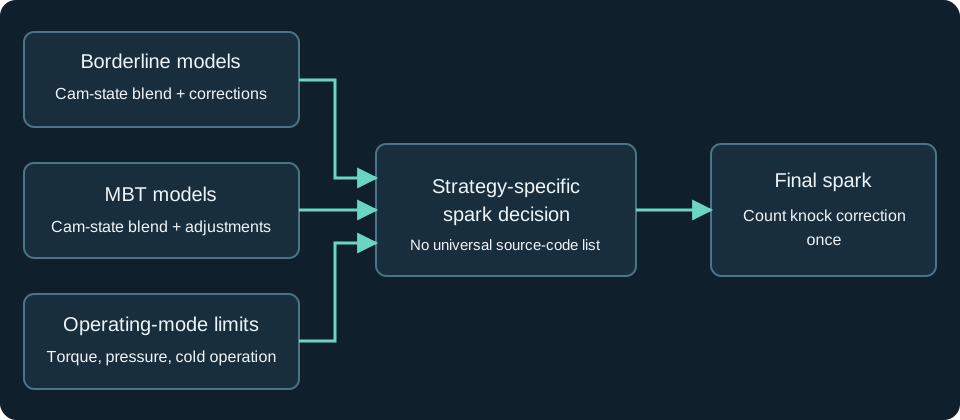
Swipe or use the arrow keys to read every label.
Coyote spark models can blend across mapped points associated with cam states. A neighboring model can contribute even when you edited a table that appears to match the operating region. Use available weights, actual cam positions and the strategy's model definitions to identify the contributors.
Worked example: an edit diluted by the blend
- Suppose a hypothetical Mustang log shows two contributing mapped points at 75% and 25%. Their interpolated borderline values at that operating point are 20° and 24°. The weighted base is 0.75 × 20 + 0.25 × 24 = 21°, before corrections.
- Raising only the second value to 26° moves that base to 21.5°, a change of 0.5°. Final spark could move less or remain unchanged if another limit applies. These are arithmetic inputs, not suggested spark values or mapped-point assignments. Check all contributing weights and each table's rpm/load interpolation before judging the edit.
- Changing Ti-VCT can change both cylinder filling and the model blend. A timing comparison made before that change cannot establish the same knock margin afterward. Recheck spark with the new cam behavior, rather than copying an advance correction between cam schedules.
- Keep MBT intact during initial fault tracing. If the result appears MBT-limited, first establish the active value, its modifiers and the measurement supporting a different torque model. Raising a ceiling until the log looks familiar does not establish a correct model.
Read final spark separately from its corrections
- The full capture setup belongs on Logging a Coyote. For spark diagnosis, the channel dictionary matters as much as the graph. Save each parameter's name, ID, units and any custom display math.
- Distinguish final delivered spark from a borderline lookup, corrected borderline estimate and MBT estimate. Determine whether each intermediate channel already contains temperature, mixture or other adjustments. Adding a correction to an already corrected trace counts that effect twice.
| Signal group | What to establish | Limit on interpretation |
|---|---|---|
| Final spark advance | Delivered or commanded final angle, units and sign | A final channel already includes the controller's corrections. |
| Borderline and MBT estimates | Raw lookup versus adjusted estimate; active mapped-point blend | A table screenshot cannot replace the live model context. |
| Knock correction | Advance/retard convention; global or per-cylinder reporting | A quiet global channel can leave cylinder activity unobserved. |
| Spark source and torque state | Supported source labels, shift state and torque intervention | A source code needs this strategy's dictionary. |
| Fuel and supply | Commanded and measured lambda by bank; relevant actual and desired fuel pressures | A target pressure is not a supply measurement. |
| Operating conditions | Speed, load/aircharge, pedal, blade, temperatures, cams, gear and mode | Matched rpm alone does not establish a matched operating point. |
| Octane learning | Availability, enable state, definition and scale | An inferred value cannot certify the tank's octane. |
A useful steady-event trace has stable mixture, pressure following demand, known cam behavior and no overlapping shift intervention. It can still show adaptive advance or retard. A smooth final-spark line alone cannot establish combustion quality or measured MBT.
- A suspect comparison has pressure or lambda changing before spark falls, an unrecorded mode change, or a silent unsupported knock channel. Correct that missing evidence first. Otherwise, a table edit can hide the symptom while the original problem remains.
- Retain the native recording and use a common time axis. Check sample timing before deciding which event began first. Sparse channels can make a pressure drop appear simultaneous with a spark correction even when their actual sequence differs.
Diagnose timing below the table before editing it
- Confirm the file belongs to the recording. Match controller IDs, calibration revision, fuel and hardware. Stop if the log predates the tune or the fuel is uncertain.
- Resolve the fuel evidence. Compare measured lambda by bank and actual pressure against demand through the complaint. Stop spark changes when delivery, sensor validity or mixture distribution is unresolved.
- Choose the event. Separate steady acceleration, tip-in, idle and the shift itself. Stop a steady-spark comparison if a torque intervention occupies the same interval.
- Identify the active model. Read cam positions and available mapped-point weights, then locate the contributing tables and axis cells. Stop if the active blend remains unknown.
- Account for corrections once. Determine what the logged borderline and MBT channels already include. Stop arithmetic reconciliation if their definitions are missing.
- Read the limiting path. Compare final spark, supported source labels, knock response and operating conditions. Stop advance changes if a pressure, temperature or torque-control cause explains the reduction.
- Make a local, reversible correction. Change only the evidenced region and document the objective. Stop if the change requires disabling a protection or guessing a parameter's direction.
- Compare the same conditions. Retain fuel, cams, gear, load and thermal context. Reject a change when knock response worsens, fuel delivery deteriorates or another operating region develops a problem.
For a confirmed borderline calibration error, inspect every contributing mapped point in that region. This does not mean increasing all tables equally. Preserve differences that belong to different cam states, and check transitions between the edited and untouched regions.
- If another path wins, increasing borderline can leave final spark unchanged. That observation supports checking the active limit and write identity. It does not support increasing the edit until some other mode receives excessive advance.
- When evaluating a spark change, compare repeatable torque under matched conditions. If extra advance produces no repeatable gain, retain the less advanced result. Absence of knock, especially on ethanol, cannot identify that torque plateau by itself.
- Knock or deteriorating supply can constrain the combination before measured MBT. Record that constraint instead of labeling the last knock-free point as MBT. There is no fixed extra advance allowance or universal subtraction that establishes margin for every fuel and thermal condition.
Worked comparison: the first change in the trace
- In a hypothetical Gen 3 Mustang log on a dedicated ethanol calibration, actual fuel pressure stops following demand during steady acceleration. Measured lambda then moves leaner than command, followed by cylinder retard and lower final spark. Suspend advance work while investigating the pressure path, both banks and injection-duration evidence.
- Check channel definitions and sample timing before accepting that sequence. After the supply or measurement fault is corrected, compare the same fuel content and thermal conditions. Restored pressure tracking and mixture control support another spark comparison; they do not establish MBT. This example is a diagnostic sequence, not a recorded failure or a test to reproduce.
Reported truck complaint: pedal stab versus gradual application
- A Gen 3 2018 F-150 case described lower timing when the pedal was applied abruptly than during gradual application. Temperature and suspected noise were also discussed. The report did not establish a single verified repair, so it cannot supply a truck timing target.
- For that complaint, capture tip-in torque control and knock correction separately. Compare actual cams, mixture response and the relevant temperatures through each event. A quick recovery suggests a different control history from lingering knock correction, but recovery shape alone cannot establish the cause.
- Keep the diagnosis on the truck's own aircharge and spark model. Matching a Mustang's peak timing would not resolve a transient-control question. If the available channels cannot distinguish the events, improve the capture before changing a table.
Use the symptom to choose the next check
| Observed problem | Evidence to compare | Next action |
|---|---|---|
| Final spark ignores the edited table | Mapped-point contributors, source, corrected model values and file revision | Locate the active path before changing magnitude. |
| Knock appears with falling pressure | Supply sequence, lambda by bank and correction timing | Resolve delivery before making a spark comparison. |
| Retard appears only when the pedal is stabbed | Tip-in source, actual cams, mixture transient and cylinder correction | Separate torque control from sensed knock; investigate each. |
| Global knock remains quiet | Control mode, cylinder channels and channel support | Repair the capture gap before declaring knock absent. |
| Spark plunges during an upshift | Shift request, torque-control source and separate knock trace | Trace the torque cut without treating it as a borderline fault. |
| One cylinder repeatedly reports retard | Cylinder-specific fuel/ignition evidence, noise sources and reporting definition | Investigate the repeated location; retain detection. |
| Hot operation has lower spark | Actual temperature corrections, lambda, pressure and knock response | Explain the thermal difference before removing correction. |
The table selects an investigation; it does not diagnose a component from one trace. A noisy event and a fuel-delivery problem can coexist. Preserve both explanations until the recording and a controlled comparison distinguish them.
Read timing bounds from the matching file
- No universal Coyote timing range is established here for stock engines, bolt-ons, aftermarket cams, boost or ethanol. A peak angle from another car does not define this engine's borderline curve or MBT model. Mustang observations also cannot supply missing F-150 cells.
- For each contributing table, record its rpm and load axes, angle units, interpolated value and relevant adjustments. Read allowed knock advance, retard behavior and pressure-related ceilings from the matching definition. If a parameter's semantics remain unclear, keep it unchanged and record the gap.
Hypothetical Gen 2 Mustang log: final Spark Advance reads 23° and a separate knock-correction channel reads −7°. Final spark remains 23°; it is not 30°. These values illustrate channel interpretation, not stock timing, measured MBT or a calibration target.
If the 23° channel instead represents an uncorrected borderline lookup, its name and definition change the calculation. Other corrections and limits still matter. Do not reconstruct delivered spark from a guessed label.
- For the US/Canada Gen 3 2018 Mustang GT 5.0 on its factory gasoline calibration, the minimum is 87 AKI, meaning (R+M)/2. Premium rated 91 AKI or higher is recommended for performance. Fuel above 15% ethanol and E85 are excluded. These are factory fuel limits, not permissions for a custom calibration or an F-150 specification.
- A custom ethanol calibration needs compatible delivery, characterization and fuel-content handling. Its spark model must match the intended fuel conditions. Better knock resistance does not automatically justify a timing adder, and adaptive knock control does not convert the stock gasoline calibration to ethanol operation.
Is your octane adjust working
First establish that the actual strategy implements, enables and exposes the parameter you are watching. Neither a universal OAR scale nor identical learning behavior is established across Gen 1–3 Mustang and F-150 applications. A display named inferred octane may also include custom scaling.
Record the parameter ID, definition, display conversion and relevant enable conditions. Compare its behavior with final spark, knock correction and the active source during matched operation. A number that stays fixed after refueling does not, by itself, establish failed learning.
Do not clear keep-alive memory just because a displayed value disagrees with the pump label. A reset changes the learning history you are trying to understand. Establish the controller-specific reset and relearn requirements before using that operation as part of a diagnosis.
In practice, the useful question is whether fuel-related adaptation changes delivered spark in the region being tested. A ceiling or another intervention can mask that effect. If octane learning is unavailable, label the evidence missing instead of importing an EcoBoost convention.
Does this knock graph look like real knock or false knock
Graph shape cannot settle that distinction. Stair steps, blocks and slow recovery can reflect the controller's response, sample rate and display processing. Identify whether the trace represents a sensed event, an accumulated correction or final advance before interpreting its shape.
Check the event's relationship to load, temperature, pressure, lambda, cam motion and driveline movement. Investigate exhaust contact, brackets, mounts and sensor installation when the evidence supports noise. Use independent knock assessment where available, and keep combustion knock plausible until the evidence excludes it.
In a reported Gen 2 twin-turbo Mustang case on pump gasoline, knock appeared at tip-in and one bank repeatedly showed correction. The owner had altered sensor gain to suppress the symptom. Replacing both knock sensors reportedly allowed a return to stock scalars with similar behavior.
That account supports checking the sensing hardware; it does not establish a gain recipe.
Inspect connectors, wiring condition, mounting surfaces and installation against the engine's service procedure before condemning a sensor. After a confirmed repair, compare the same event with documented sensor settings. A quieter trace after desensitizing detection cannot demonstrate that the original fault was repaired.
Unchanged retard after one timing or fuel change is inconclusive. Learned response, channel filtering and mixed causes can obscure the comparison. Do not raise thresholds or change gain direction on that evidence. An unexplained event remains a reason to stop adding advance.
Is the huge negative spike on the shift detonation
First identify which trace went negative. A plunge in final spark during a torque-control event is different from a knock-correction value indicating advance. Read the shift state, source label and separate knock response together.
A reported Gen 3 2019 twin-turbo Mustang case showed shift torque management driving spark sharply retarded. Sensed knock also appeared near the shift. The torque intervention explained the large final-spark drop, but it did not prove the separate knock signal was mechanical noise.
The owner also reported that tightening the plug gap made no detectable difference to the shift complaint. That unsuccessful change matters: it did not repair the control request. There is no transferable plug-gap setting or shift-torque value in this account.
Investigate an excessive torque cut through the actual torque request and delivered response. Keep the clutch-protection purpose visible. Increasing borderline or changing plug gap does not explain a torque request that the spark system is attempting to meet.
Review the recovery after the event as well as its minimum angle. Knock recovery and deliberate shift control can overlap. If the source dictionary or transmission request is unavailable, preserve the uncertainty instead of identifying the cause from the negative peak alone.
Questions about Coyote spark calibration
When knock retard is negative, is it adding?
That convention appears in some Ford logs, but another channel can use the opposite sign. Read the exact parameter description and any custom math, then label advance and retard explicitly. A negative final-spark angle means something different from a negative correction. Keep both traces named in screenshots and exports.
When comparing recordings from different Scanner setups, reconcile their definitions before comparing their magnitudes. Never add an advance correction to final spark again. If the definition is unavailable, report the sign as unresolved and retain the raw log for review.
How does knock advance work?
Where enabled, knock-system advance can move timing beyond the borderline starting value within the strategy's permitted limits. Its rate, operating conditions and ceilings determine what reaches final spark. That behavior does not establish measured MBT or justify intentionally finding knock repeatedly.
Read the actual advance limits and active path before moving an observed correction into borderline. Otherwise, the original advance allowance may still apply above the raised table. A short acceleration and a longer sustained event can also show different adaptation without requiring different table values.
Can I write the knock advance back into borderline?
A learned advance value is conditional on that event's fuel, temperature, cams and load. Moving it into borderline can leave the original advance allowance available above the raised base. For example, a hypothetical 20° base plus 3° adaptive advance gives 23° before other limits.
Raising the base to 23° while retaining that allowance could permit 26°, if the same correction and limits allow it. This illustrates double counting, not a timing recommendation. Review the complete advance path before making a local base-table correction.
Why does spark climb farther in higher gears?
Compare elapsed time in the same load and cam region, along with knock history and active limits. A slower rpm rise can leave more time for adaptive advance. In a reported 2015 manual Mustang case, changing one fast-advance setting changed the observed steps; other rate edits did not clearly speed the climb.
That is a reported response, not a setting to copy.
The legacy label Knock Fast Advance Rate vs. RPM uses seconds per degree, so a larger value means slower advance. Knock Recovery Rate instead describes larger values as faster recovery. Confirm the actual strategy's labels, units and enable conditions before editing either. A rate, a per-loop step and an advance limit serve different purposes.
Should I edit high-load rows until it knocks?
Do not use repeated knock as the endpoint. First resolve fuel delivery, actual cam positions, model contributors and correction accounting. A confirmed borderline error calls for a local change supported by repeatable torque and knock evidence. Stop when additional advance gives no repeatable gain, or earlier if knock or supply becomes limiting.
A quiet knock trace alone cannot locate MBT, and raising MBT to let an experiment continue changes the torque model too.
Should I copy borderline into MBT?
Preserve their separate roles. Copying one into the other changes a model used in torque calculations, while providing no evidence that the new values represent torque-optimal timing. To explain low delivered spark, locate the active mapped points and compare corrected estimates with final advance.
If MBT is limiting, verify that interpretation and obtain repeatable torque evidence before revising it. A ceiling raised solely to permit more spark can also change behavior outside the complaint. Keep the original model available for comparison and check idle and transitions after any justified model change.
Are you set to per-cylinder retard?
Confirm both the control mode and the reporting support. On some strategies, a global knock channel can remain quiet while cylinder-specific correction is active. Missing cylinder PIDs do not establish absent correction, and a populated global PID does not establish visibility into every cylinder.
Save the supported channel list and check that the selected channels actually update. Do not change knock mode simply to fit an existing layout. If the strategy cannot expose the required evidence, record that limitation and avoid declaring the calibration knock-free from the global trace.
How much timing on premium gasoline, and will straight E85 reach MBT?
Neither fuel name supplies a timing target. The operating point, cylinder filling, mixture, compression, temperature and fuel delivery all matter. On high-ethanol fuel, extra advance can stop producing torque without a useful knock warning.
Establish measured torque response for the actual combination, and retain the less advanced result when additional advance has no repeatable benefit. Read borderline, MBT and their adjustments from the file rather than averaging other cars' peak angles. Reaching a modeled MBT ceiling also does not prove the engine reached measured MBT.
Why is one cylinder always the one that triggers?
A repeated location is useful evidence, but it does not identify the cause alone. Compare that cylinder's available correction with fuel and ignition evidence, temperature-related behavior and possible mechanical noise. On a Coyote, cylinders 1–4 run front to rear on the vehicle's right bank; 5–8 occupy its left bank.
Cylinder 8 is therefore rear left, the driver's side on a left-hand-drive Mustang or F-150. A correction channel is a controller decision, rather than a direct measurement of cylinder pressure or injector flow. Avoid applying a permanent cylinder offset because another Coyote reportedly needed it.
Preserve detection, investigate the repeated event and verify the result under matched operating conditions.
Why did a flex-fuel spark edit make the result harder to understand?
In a reported Gen 3 2019 Mustang experiment, raised MBT values and ethanol adders stacked while the inferred fuel content remained questionable. The corrective advice was to restore MBT and resolve fueling before further spark work. No damage was established in that account.
The useful lesson is to validate content inference, pressure and mixture before evaluating fuel-dependent advance. A fuel-content display and an ethanol adder cannot validate each other. Compare each against independent fuel evidence and keep the gasoline and ethanol model changes traceable.
How much does humidity move the knock limit?
A supercharged Gen 3 owner reported more cylinder retard on a drier day with the same tune and similar ambient temperature. The comparison supports recording dew point alongside fuel, charge temperature and knock history when a previously quiet combination changes behavior.
It does not establish a correction per degree of dew point or prove that every seasonal knock complaint is humidity. Verify the fuel and engine conditions too. Do not alter a temperature-sensor signal to conceal a weather difference.
Why does spark move so much at idle?
Idle spark can move rapidly as part of torque and speed control. Cold catalyst heating can also command retarded spark under a different operating path. Compare desired and actual idle speed, air control, cam behavior, temperature and active source before treating those movements as a high-load spark-table fault.
An aftermarket cam changes the air and torque behavior that idle control must manage. Diagnose that model and mechanical context separately. A steady acceleration timing target does not describe a cold start, a coast event or warm idle feedback.
After a cam-schedule change, use Ti-VCT cam timing on a Coyote to reconcile desired and actual angles with the mapped-point models before reviewing spark again.
Tune Report is free for a readable calibration and matching log, with missing spark and knock evidence recorded.
Check the Full Custom service scope for coverage. Ford Full Custom is open at $199 during the launch special ($249 regular). Every file is compared against our 3 million+ tune values, with a final check-off by our lead tuner.
Tune Report is free if you want this file checked: open the Ford Tune Report.
A written review of your tune file and one log from your car.
Start a Ford Tune Report